Published
Nepal's trails are busier than they have ever been. The Annapurna Conservation Area alone logged 246,575 foreign visitors between January and October 2025, more in ten months than in the whole of 2024. Langtang, written off by many after the 2015 earthquake, now counts over 42,000 visitors a year and fills its Kyanjin Gompa lodges in peak season. Demand has not simply recovered. It has reshaped which trails people choose.
This list is ranked on what travellers are actually booking and walking in 2026, not on which mountain is tallest. Some entries are here because they are permanently in demand; others because something specific changed this year: a permit rule, a reputation, a road. Every figure below is taken straight from our own trip sheets, so what you read here matches the trek page itself. We quote prices per trip rather than publishing them, so ask and you will get a firm one.
Nine of the ten run as scheduled Devo Adventures departures. The tenth is on our watch list, and there is more on that at the end.
1. Everest Base Camp: the one everyone still wants
No trek in the world turns a vague ambition into a booked flight quite like this one. Everest Base Camp remains the most requested itinerary in Nepal, and the pull is not really the base camp itself. It is the walk in: the Lukla flight, the suspension bridges over the Dudh Koshi, Namche Bazaar, Tengboche Monastery at 3,860m, and the pre-dawn climb up Kala Patthar for sunrise on the summit.
Our itinerary runs 14 days and tops out at 5,364m, which puts it firmly in the challenging bracket. The terrain is a walking trail throughout; it is the altitude that makes it hard. Two acclimatisation days, at Namche and Dingboche, are built in rather than optional, and they are the main reason our trekkers arrive rather than turn back.
Spring, March to May, is our scheduled season: warm enough in the lower villages, stable enough up high, and base camp is at its most alive with expedition teams preparing for their summit pushes.
2. Annapurna Base Camp, where the growth actually is
The hard numbers point here. ACAP recorded 246,575 foreign visitors in the first ten months of 2025, beating the entire previous year, and Annapurna Base Camp is the route absorbing much of that growth. It is what people choose when they want a genuine Himalayan sanctuary without the altitude risk of Everest.
The walk ends inside a natural amphitheatre, a ring of peaks standing over you at close range, with Machhapuchhre and Annapurna South near enough to feel unreasonable. Getting there takes you through rhododendron forest and Gurung villages, with the hot springs at Jhinu Danda on the way back down, which is the most welcome stop on any trail in Nepal.
At 11 days and a maximum of 4,130m, this is a moderate trek, and that is the whole point of its popularity: it delivers the full high-mountain experience while staying below the band where altitude gets genuinely unpredictable. For a fit first-timer with two weeks, it is the highest-probability trip on this list. Best in October and November.
3. Annapurna Circuit, the classic that outlived the road
The Annapurna Circuit survived the road-building that was supposed to ruin it, for a simple reason: no other trek in Nepal changes this much underfoot. You start in subtropical farmland and finish in Tibetan-influenced high desert, crossing the Thorong La at 5,416m (the highest point of any trek we run) in between.
Sixteen days is a real commitment, and it is exactly why the route is climbing again. Travellers who did a short trek a season or two ago are coming back for the long one, and the Circuit is what they book. The gradual day-by-day gain also makes it one of the better-acclimatised big treks despite that pass height.
We rate it moderate rather than challenging: the days are long but rarely steep, and the profile does most of the acclimatisation work for you. The Thorong La crossing is the one genuinely hard morning: an early start, thin air, and a long knee-punishing descent into Muktinath on the far side. October and November.
4. Manaslu Circuit: the connoisseur's pick for 2026
If one trek is being pushed hardest for 2026, it is this one. Manaslu Circuit sits in a restricted area, which has quietly protected it. You cannot walk it independently, and permits are issued only through registered agencies. Roughly five thousand people a year walk it, against several hundred thousand across the Annapurna region.
The trade is straightforward. You get a Circuit-scale journey, a 5,130m pass at the Larkya La, and villages of Tibetan origin around Samagaon that feel a generation removed from the teahouse strip on busier routes. In exchange you commit to a longer trip and a permit you have to plan around.
Seventeen days, challenging, walking under the world's eighth-highest mountain. Our trip sheet singles out October and November for the colour in the vegetation, with April and May a close second when the rhododendron is out; the full season runs mid-March to mid-June and October to mid-December. This is the one to choose if crowds are the thing that would spoil it for you.
5. Langtang Valley is no longer a recovery story
Langtang's story has changed. The valley was devastated in 2015, and for years afterwards it was described as recovering. It is not recovering any more: over 42,000 visitors now pass through the Langtang and Gosaikunda area in a year, ahead of pre-earthquake numbers, and lodge owners at Kyanjin Gompa discuss managing peak-season beds the way Namche does.
What makes Langtang Valley trend is proximity. There is no domestic flight to gamble on, since you drive from Kathmandu, and you are among 6,000m and 7,000m peaks within a few days: the Langtang Lirung glacier, Ganchhempo, Dorje Lakpa. The Tamang and Tibetan culture of the valley is its own reason to come.
Eleven days, moderate, topping out at 4,760m on Kyanjin Ri, with the option of pushing on to Tserko Ri at 4,980m for a full 360° panorama. Neither needs any climbing experience. October and November, and of the high-altitude routes we run it is the easiest one to reach.
6. Ghorepani Poon Hill, the gateway trek
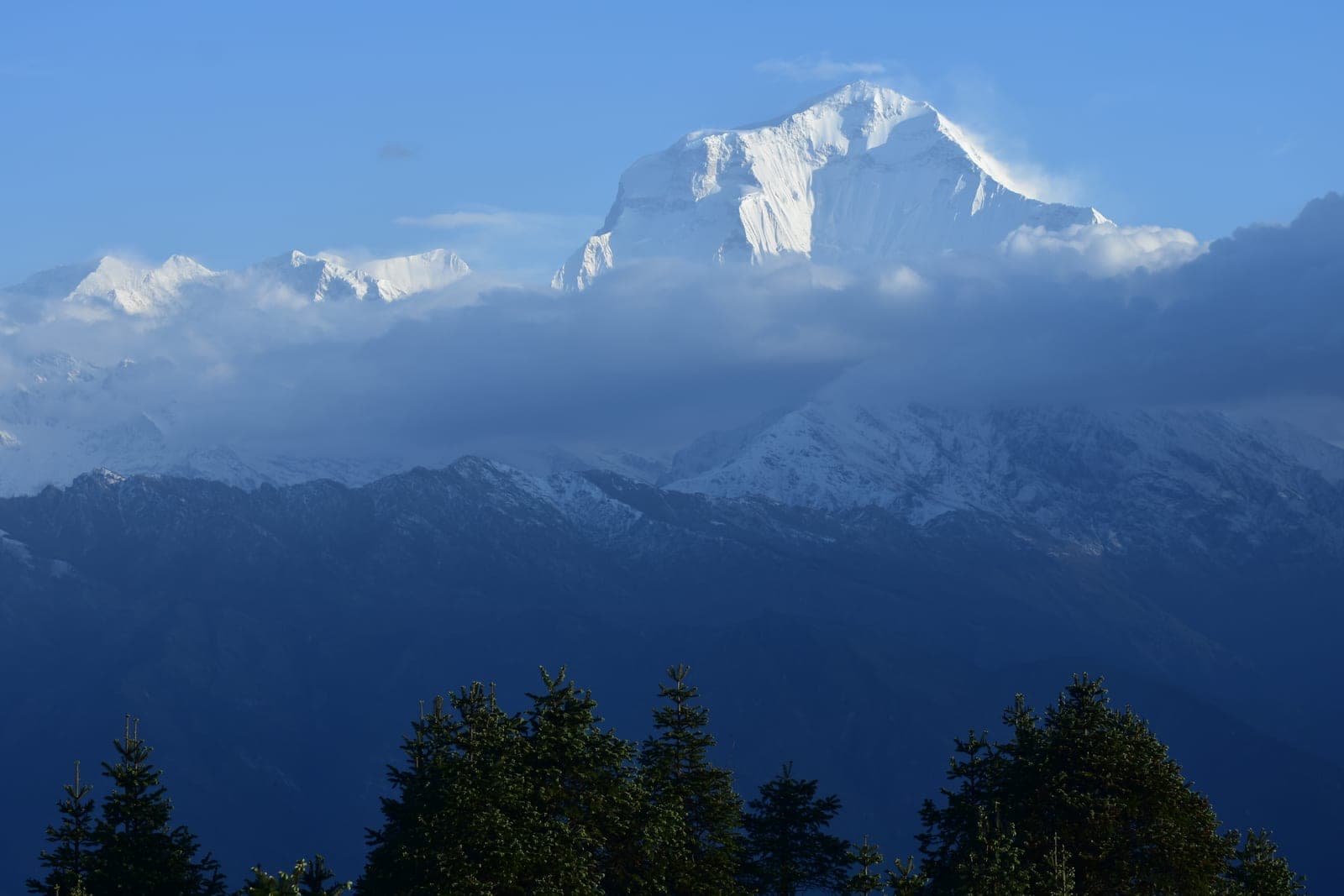
Poon Hill converts people who never thought of themselves as trekkers. The sunrise from the 3,210m viewpoint, with Dhaulagiri at 8,167m and Annapurna I at 8,091m lighting up on either side of the valley, is the most photographed dawn in Nepal, and deservedly so.
It is worth being precise about what our Ghorepani Poon Hill trip actually is: 11 days, but not 11 days of walking. The package wraps the trek in a culture tour of Kathmandu's UNESCO sites, rafting on the Trishuli, and a jungle safari in Chitwan with a real chance of seeing one-horned rhino. It is the Nepal-in-one-trip itinerary, and that combination is why it keeps selling.
The trekking itself follows an old trading route where you will still meet mule caravans, through Gurung and Magar villages and their stone houses. April and May are the best weeks of all, when the rhododendron turns the hillsides. Moderate, maximum 3,210m, March to May and October to November.
7. Gokyo Lakes: the Everest region without the queue
Gokyo is the deliberate answer to a question more people are asking: how do I see the Everest region without walking the Everest highway? Gokyo Lakes branches off the main Khumbu trail into a parallel valley of turquoise glacial lakes, and from the top of Gokyo Ri at 5,357m the panorama takes in four 8,000m peaks: Everest, Lhotse, Makalu and Cho Oyu. That is more than you see from base camp itself.
It also puts you alongside the Ngozumpa, the longest glacier in the Himalaya, a genuinely strange landscape of rubble and buried ice.
Twelve days, challenging, and the altitude profile is serious. At 5,357m you top out only seven metres below our Everest Base Camp high point, so this is not the easier option, just the quieter one. Spring, March to May. Trekkers increasingly want both, crossing the Cho La pass between Gokyo and the base camp trail; ask us if that is the trip you have in mind.
8. Mardi Himal, the best short trek in Nepal
Mardi Himal comes up more than any other name when operators are asked what is trending for 2026, and the reason is arithmetic. Seven days. 4,500m. That ratio does not exist anywhere else in Nepal.
Mardi Himal climbs a forested ridge east of the Annapurna Sanctuary, and the final day walks an exposed spine with Machhapuchhre standing directly ahead at close range, the fishtail peak that is still unclimbed and officially closed to climbers. A small trek with a very large payoff.
It suits the traveller with ten days of leave rather than three weeks, which is why it has become the standard recommendation for anyone who wants high-mountain views without spending a month of annual leave on them. The trail was barely walked a decade ago, and the teahouses along it are newer and simpler than the Annapurna Base Camp strip, which for most people is part of the appeal. Moderate, October and November, and the shortest commitment on this list.
9. Upper Mustang and the year's biggest rule change
Upper Mustang is on this list because of a permit change, not a fashion. Until late 2025 the restricted-area permit was a flat USD 500 for ten days, which priced out anyone wanting a shorter trip. In November 2025 Nepal replaced it with USD 50 per day, and in March 2026 dropped the two-trekker minimum, so solo travellers can now obtain a permit at all. In four months a short Mustang trek went from expensive and off-limits alone to neither.
That matters because Upper Mustang is unlike anywhere else on this list. It is a former Tibetan kingdom in the rain shadow behind the Annapurnas, with sky-caves cut into eroded cliffs, cliff monasteries, and the walled medieval city of Lo Manthang at the end of the road.
It is also the one Nepal trek that is better in summer. The monsoon that floods the rest of the country largely misses it, so our season runs May to September, exactly when the other nine here are washed out. Twelve days, moderate, maximum 3,840m.
10. Khopra Ridge: the one to watch
Khopra Ridge, or Khopra Danda, turns up in every 2026 'what's next' list alongside Mohare Danda, and it is following the path Mardi Himal took five years ago: a quiet community-run lodge trail in the Annapurna region that is unlikely to stay quiet.
It is a five to seven day walk to a ridge at 3,640m looking straight across at Dhaulagiri and Annapurna South, with an optional day up to Khayer Lake at 4,600m. The difficulty sits between Poon Hill and Mardi Himal: harder than the first, less exposed than the second. It shares Poon Hill's permits, and the lodges are owned by the villages rather than by individual families, so more of what you spend stays in the valley.
Best from mid-October to November, or February to April. This is the one trek here we do not yet run as a scheduled departure, so if it is the trip you want, send us an enquiry. We guide this region every week, and we will build the itinerary around your dates.
A pattern runs through all ten. The treks gaining ground fastest are not the hardest. They are the ones that fit a realistic amount of leave: seven days at Mardi Himal, eleven at Annapurna Base Camp, a short Mustang trip that a permit change finally made affordable. The long classics are not going anywhere, but the growth is in trips that do not demand a month away.
If one of these is already fixed in your head, every trek above links through to its full itinerary, day by day, with what is included, what is not, and the real altitude profile. You can browse the complete range on our treks page.
And if you are still deciding, that is the more useful conversation to have. Tell us your dates, your fitness and how long you have, and a guide who walks these trails will come back within 24 hours with an honest recommendation, including telling you when the trek you asked about is not the right one for you.
Ready to start planning?
Tell us your dates and fitness level, and a real guide replies within 24 hours with a tailored itinerary.